On December 30, 2025, my good friend Leanne—hailing from Australia, the home of my kids’ favorite show, Bluey—sent me an Instagram reel by Sean Conway. The post detailed the “496 Challenge” for January 2026, opening with a daunting statistic: only 10% of those who start actually finish. At the time, I didn’t know much about Sean and was fully focused on my Ironman 70.3 Colombo Relay training, so I simply replied with a “:O” emoji and moved on.
But the seed had been planted.
As my curiosity grew, I looked into the man behind the challenge. For the uninitiated, Sean Conway is a powerhouse endurance athlete and performance mentor (you can see his full list of accolades here). To put it simply: he was the first person to swim the length of Britain and once completed a staggering 105 consecutive Iron-distance triathlons. With a pedigree like that, the challenge started to look a lot more serious.
What is the 496 challenge?
The core concept of the 496 Challenge is straightforward: pick a 31-day month and run the number of kilometers that corresponds to the date. For example, Day 1 is 1km, Day 2 is 2km, all the way up to 31km on the last day. By the end of the month, you’ve covered a massive 496km (1 + 2 + 3 + … + 31 = 496).
While the original challenge was pitched for January, you can tackle it during any month with 31 days. My initial reaction was hesitation—with the Ironman 70.3 Colombo scheduled for February 22nd, March seemed like the only window, but the logistics felt impossible. I simply couldn’t imagine carving out three hours for a 25km+ run on a Monday or Tuesday without either being a zombie at the office or missing precious evening time with my family.
That is when I discovered the variations that make this feat more accessible:
- The Classic: The standard 1 to 31 progression.
- The Reverse: Starting at 31km and decreasing by 1km each day.
- The Tombola: Drawing numbers 1 through 31 randomly from a hat each day.
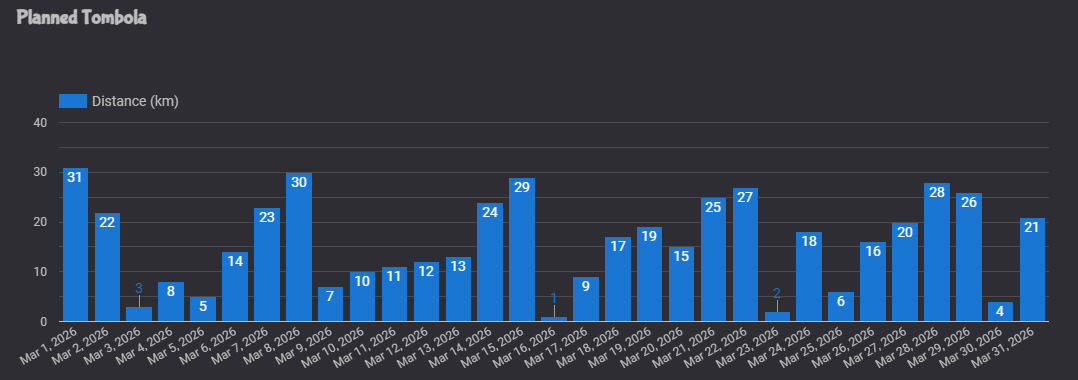
- The Planned Tombola: Mapping out days 1 through 31 in advance to fit your specific schedule.
- The Pyramid: Running odd numbers up to 31, then even numbers back down to 2.
The Planned Tombola immediately clicked for me. It was a puzzle I knew I could solve, allowing me to leverage my project management expertise to bridge the gap between a daunting physical challenge and the realities of my daily life!
The Planned Tombola
I spent a few days weighing the risks: Could I handle the mileage without injury? Would it compromise my work or time with my family? Morning or night? Before committing, my first priority was pitching the idea to my wife to get her blessing—and the core points of that pitch became the foundation of my strategy.
The pitch was a success! We decided that early mornings would be my primary window. My goal was to finish each run in time for the school run. On office days, I’d shower at work; on work-from-home days, I’d shower after dropping the kids off. To keep things seamless, I committed to prepping uniforms and bags the night before. Choosing mornings was also a tactical move against the Sri Lankan weather; March and April bring scorching equinox heat and unpredictable evening thunderstorms. Running early ensured that if I did miss a session, I still had the evening as a safety net, while also maximizing my recovery time between runs.
Next came the project management phase. I fired up a Google Sheet to map out the month, layering in several variables:
- The Calendar: Marking weekends and the lone public holiday.
- Work Commitments: Highlighting office days and our Q2 Planning sessions (two of which were at Hilton Residencies).
- Family Milestones: Identifying a very busy stretch of birthdays and our anniversary.
With the constraints set, I began slotting in the distances. I decided to tackle the beast head-on by running the full 31km on Sunday, March 1st. I then reserved the 21km for the final day—ending the month with a celebratory Half Marathon.
The middle of the month became a “numbers game” for our family celebrations: I slated 10km for our 10th wedding anniversary on the 10th, 11km for my birthday on the 11th, and 12km for my wife’s birthday on the 12th. I even leaned into the superstition of Friday the 13th by assigning it the 13km slot. Finally, I adjusted my weekend plans to honor my father’s 80th birthday on the 28th with a fitting 28km run!
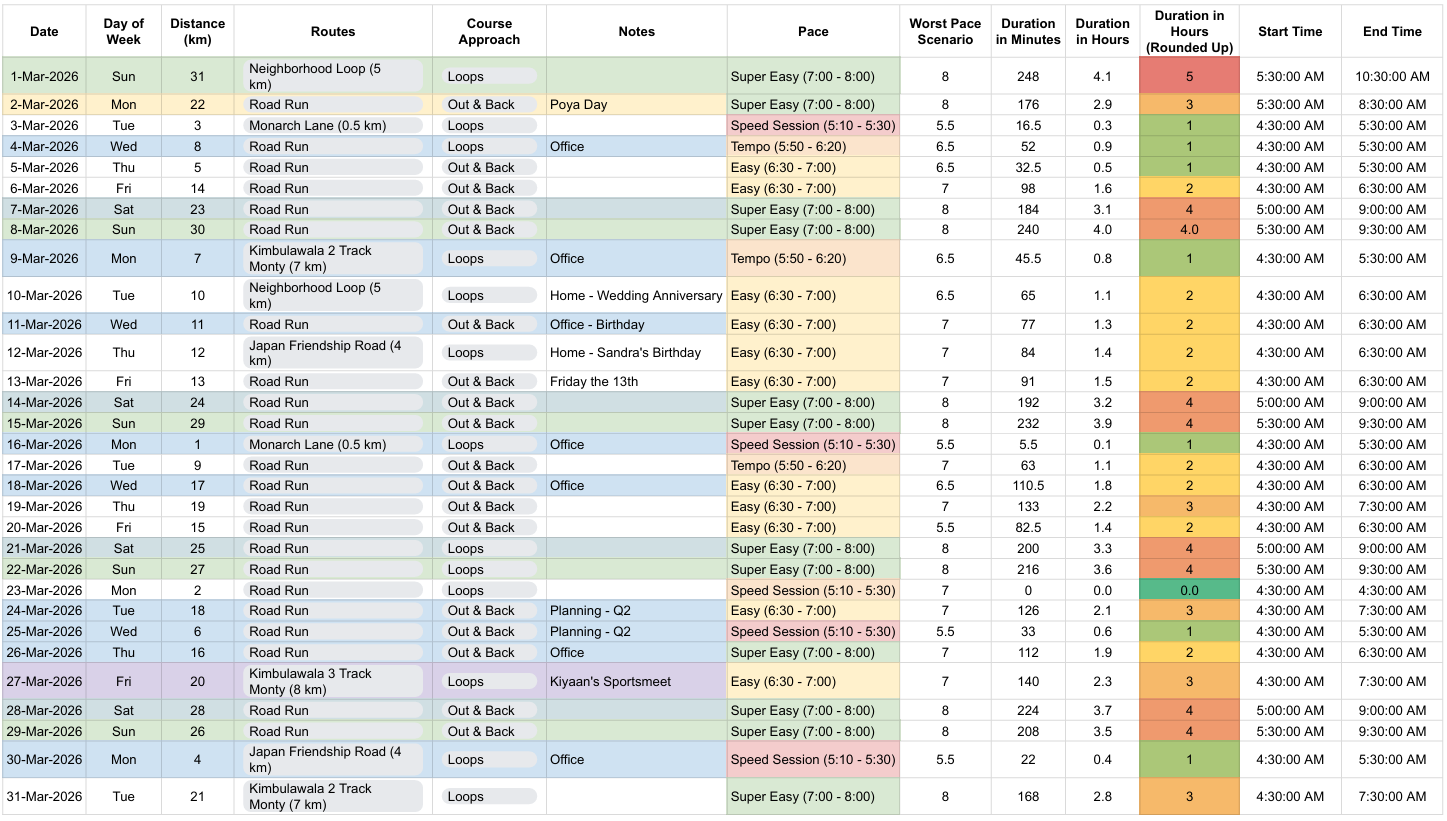
Once the distances were locked in, I shifted my focus to the methodology for each run. My primary objective was total volume rather than speed, so I prioritized variety over a fixed pace. By varying my intensity across the 31 days, I could maintain my $VO_2$ max and minimize injury risk while accurately estimating the time required for each session.
I categorized the runs based on distance to manage my effort effectively:
- Aerobic Base (21km – 31km): These were “Super Easy” runs with a target pace of 7:00 – 8:00 min/km. The goal was to stay strictly in Zone 2 to build endurance without overtaxing my system.
- Easy Runs (11km – 20km): Conducted at a comfortable pace of 6:30 – 7:00 min/km.
- Tempo Sessions (6km – 10km): Stepping up the intensity with a target pace of 5:50 – 6:20 min/km.
- Speed Work (1km – 5km): Short, high-intensity bursts to keep my legs sharp.
To ensure my schedule remained realistic, I calculated the duration of each run based on a “worst-pace” scenario (see what I did there!). I also mapped out specific routes: I utilized the various running tracks around Thalawathugoda for speed sessions and shorter efforts, while the longer distances were designated as road runs to simulate race conditions.
You will find the detailed breakdown of my plan below.
The Scale of the 496 Challenge
To truly understand the magnitude of running 496km in 31 days, it helps to put the numbers into perspective.
Normally, I average between 100–120km per month, maintaining a weekly volume of roughly 40km. Even at my peak—while training for last year’s LSR Colombo Marathon—I was hitting about 60km per week. Tackling 496km means I am effectively cramming nearly five times my usual monthly mileage into a single month.
Looking at the bigger picture, over the last two years of consistent, intentional running, I’ve averaged between 1,200 and 1,400km annually. This challenge alone represents about 40% of my entire yearly output, all within a 31-day window.
Perhaps the most daunting statistic is the frequency of long-distance efforts. My plan includes 11 runs equal to or longer than a half marathon (21km). To compare: during my full marathon training block, I only tackled four such distances per month. This isn’t just a step up; it’s a completely different level of endurance.
Hospitalizations, Funerals, and the Art of the Pivot
The month began with a sobering reality check. On March 1st—the same morning I conquered the 31km run—we visited my father’s eldest sister, my Loku Nandi, at Jayawardenapura Hospital. I spent that visiting hour balanced between family duty and the physical exhaustion of the morning’s mileage.
By March 5th, just five days into the challenge, the situation grew heavier. I had just returned from an active recovery nature walk with my kids when my parents shared the news that my uncle (my mother’s brother-in-law) had passed away in Daraniyagala. We immediately prepared to travel to the remote village of Avissawella that Saturday for his final rites.
Then came the phone call every runner dreads during a high-volume block. At 11 PM, just as I was settling in for much-needed sleep before an early run, my father—who lives in the same house—called my mobile. “Were you sleeping?” he asked, followed by the news that the hospital had called: Loku Nandi had passed away.
My 14km run on Friday, March 6th, became an emotional, symbolic journey, as the 14th of March would have been her birthday. After a half-day at work, I drove my mother to Daraniyagala to pay our respects to my uncle. It was an exhausting day, but I still managed to lace up the next morning for my planned 23km. Coincidentally, my out-and-back route took me right toward the Borella Cemetery and the nearby funeral parlor where we would later gather for Loku Nandi’s burial.
The health scares didn’t end there. On March 16th, while working from home, I walked out of my office to find the house in a state of commotion; my father was experiencing chest pains. We rushed him to the hospital, where he was admitted to a bed only a few spots away from where Loku Nandi had been just weeks prior. Thankfully, it wasn’t serious, but he was kept overnight for observation before being discharged the following day.
Adding to the month’s complexity, regional tensions in the Middle East sparked panic buying and fuel shortages. In response, ParentPay shifted to a WFH policy, and my kids moved to online schooling. While the circumstances were stressful, they provided a much-needed silver lining: the extra breathing room on weekday mornings meant I no longer had to race against the clock for school drop-offs. Finally, a bit of luck had swung my way!
Planning, Execution, Monitoring, and Control
Managing the sheer volume of the 496 Challenge required a sophisticated approach to hydration and fueling. I learned early on that as dawn turned to late morning, the heat became oppressive. By the first week of March, the Met Department had already issued “heat caution” warnings. This spike in temperature made maintaining a Zone 2 heart rate nearly impossible—even while walking.
To adapt, I implemented a strategic run-walk method for the longer distances and designed my routes as short loops or out-and-back segments. For my 31km run, I completed six 5km loops starting and ending at my front door (yes, there was a 1km loop at the end to complete the 31km). This effectively turned my home into a personalized aid station; I didn’t have to carry heavy fluids, and I could stop for a quick tea or snack between sets. This “Agile” approach of incremental delivery—blended with the logistics of an ultra-marathon—provided a massive physical and mental boost.
My technical workflow was equally disciplined:
- Weekly Sprints: Every Sunday evening, I reviewed the upcoming week’s schedule. I would cross-reference my planned intensity (speed, tempo, or easy) with my current recovery levels, pivoting the strategy if a session felt too taxing for the surrounding days.
- Garmin Integration: Once confirmed, I synced the specific paces and workout breakdowns to my watch via Garmin Connect for seamless daily execution.
- Data Visualization: To stay motivated, I built a custom dashboard in Google Looker Studio that pulled data directly from my tracking sheet. Every evening at 7:30 PM, an automated report landed in my inbox, providing a clear snapshot of my progress and the road ahead.
This combination of project management rigor and real-time adaptability was the only way to keep the challenge on track.
In conclusion: here I stand, 31 days and 496 kilometers later, the first Sri Lankan to join the ranks of the Sean Conway 496 Challenge Hall of Fame!
 Extraordinary pages of an ordinary life