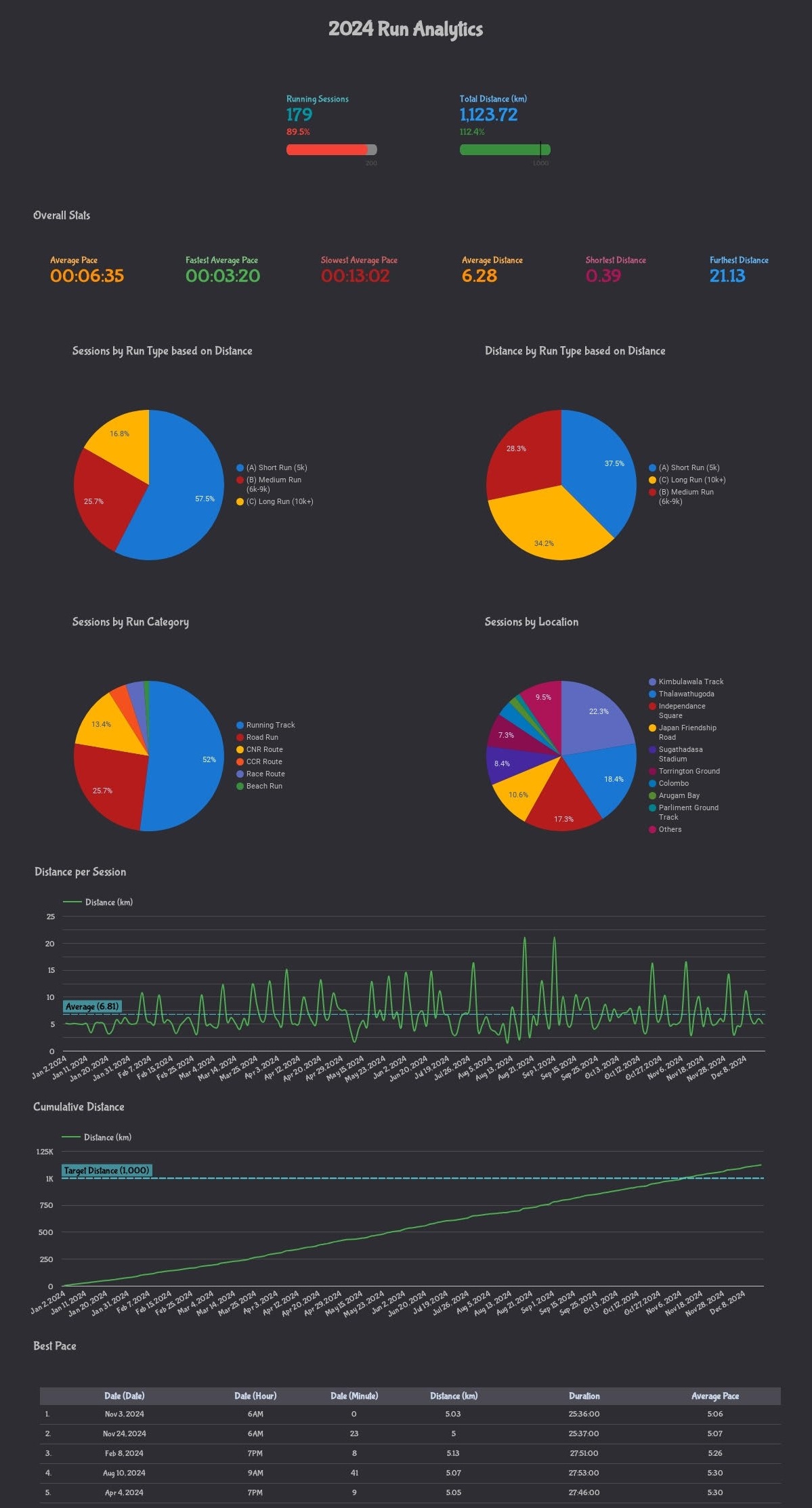
I kicked off 2024 with a New Year’s resolution: to run 1,000 km by the end of the year. I committed to running four days a week—simple math told me that if I ran 5 km per session, I’d reach 1,040 km by year’s end. But the real turning point in my running journey came when I joined the Colombo Night Run (CNR), a weekly 5K that begins and ends at Independence Square in Colombo. It was at CNR that I truly learned how to run.
I’ve always considered myself fairly athletic, having played various sports over the years. And like many former athletes, I had a bit of arrogance—I assumed running was just a matter of lacing up my shoes and heading out the door. Boy, was I wrong.
The post-run conversations with fellow runners at CNR taught me more than I expected. I rediscovered the fundamentals—dynamic vs. static stretching, different types of runs (easy runs, interval training, tempo runs, long runs), cross-training, hydration strategies, and so much more. A few months later, I joined Colombo City Run (CCR), where we explore different routes around the city for our Sunday morning long runs.
Being part of a running community or run club is an incredible experience. The support, motivation, and guidance you receive are invaluable. It not only fuels your passion for running but also drives you to challenge yourself and improve. Plus, you hear about races happening all across Sri Lanka—not just to participate, but to compete.
Which brings me to the topic of this article: running a half marathon. This is not just a story about training—it’s about how I applied lessons from my day job as a Project Manager to prepare for, train, and run my first half marathon.
As a project manager, you’re no stranger to deadlines, meticulous planning, and executing complex tasks. So, what if I told you that training for and completing a half marathon is essentially just another project? It’s a project with a tangible (and sweaty) deliverable: crossing that finish line. This guide will break down how to approach your half marathon training with a project management mindset.
1. Defining Scope and Objectives (Setting Your Race Goals):
Just like any project, you need clear objectives. Simply saying “I want to run a half marathon” isn’t enough. Define your goals:
- Completion Time: Do you aim to finish within a specific time? (e.g., under 2 hours, finish strong regardless of time). This sets the scope of your training intensity.
- Race Selection: Choose a race that fits your timeline and experience level. Consider the terrain (flat, hilly), weather conditions (hot, cold), and race organization. This is your project’s environment.
- Personal Best (PB): If you’ve run a half marathon before, set a target for a new personal best. This is your project’s performance metric.
2. Work Breakdown Structure (Training Plan):
Divide your training into manageable phases, similar to project phases:
- Base Building (Weeks 1-4): Focus on building a solid foundation of mileage. This is your project’s initiation phase, focusing on establishing the groundwork.
- Increasing Mileage (Weeks 5-8): Gradually increase your long runs and weekly mileage. This is your project’s execution phase, where the core work happens.
- Tapering (Weeks 9-10): Reduce mileage to allow your body to recover before the race. This is your project’s closing phase, preparing for delivery.
- Race Week (Week 11): Final preparations, rest, and carb-loading. This is your project’s deployment phase.
Within each phase, define specific tasks:
- Long Runs: Gradually increase the distance of your longest run each week.
- Easy Runs: Maintain a comfortable pace for shorter runs.
- Interval Training: Improve speed and endurance with high-intensity workouts.
- Cross-Training: Incorporate activities like swimming or cycling to prevent injuries.
- Rest Days: Crucial for recovery and preventing burnout (just like project buffer time).
3. Resource Management (Gear and Nutrition):
Every project needs resources. For a half marathon, these include:
- Running Shoes: Invest in good quality running shoes that fit properly.
- Running Apparel: Choose comfortable and breathable clothing.
- Nutrition: Develop a nutrition plan for training and race day.
- Hydration: Stay hydrated throughout your training.
4. Risk Management (Injury Prevention):
Identify potential risks and develop mitigation strategies:
- Injuries: Implement proper warm-up and cool-down routines, listen to your body, and don’t overtrain.
- Weather: Be prepared for different weather conditions.
- Nutrition Issues: Practice your race-day nutrition during training.
5. Communication and Reporting (Tracking Progress):
Monitor your progress and track your workouts using a running app or journal. This allows you to:
- Track Mileage: Monitor your weekly and overall mileage.
- Monitor Pace: Track your pace and identify areas for improvement.
- Adjust Training: Make adjustments to your training plan as needed.
6. Project Closure (Race Day):
Race day is your project’s culmination. Execute your plan, stay hydrated and fueled, and enjoy the experience. Crossing the finish line is your successful project delivery.
Now, let me share some experiences from the two Half Marathons that I ran in 2024.
My First Half Marathon: The Arugam Bay Experience (18th August 2024)
The Arugam Bay Half Marathon (AGB HM) was my first-ever half marathon, and my only goal was to cross the finish line. Time wasn’t a concern—after all, whatever time I clocked would be a personal best. Based on feedback from friends who had run in Arugam Bay before, I knew the course would be tough. So, I went in with managed expectations and a mindset focused on completion, not competition.
I trained using Garmin Coach, following a structured 12-week program that included easy runs, tempo sessions, intervals, and long runs. However, my training schedule hit a major speed bump: the Mercantile Athletic Meet, where I competed in the 1500m and 5000m events in the 35+ category. Preparing for the meet conflicted with my half marathon training, and to make things more challenging, the AGB HM took place just a week after the meet.
As I became more serious about running, I decided to invest in a Garmin Forerunner 255, which gave me invaluable insights into my performance and progress. I also added a few pairs of running shoes to my gear collection. The standout among them? The Brooks Adrenaline GTS 23—a game changer. I had developed shin splints while training for the Mercantile Meet, but when I ran the AGB HM in the Adrenalines, I felt no pain at all. I also picked up a hydration belt for carrying water and wore ASICS socks that turned out to be incredibly comfortable.
In terms of nutrition, I have to admit I wasn’t as prepared. I stayed hydrated and took electrolytes before and during the race, but my attempt at carb-loading was misguided at best. Thankfully, I ran alongside a friend from Colombo City Run, who generously shared an energy gel with me when I started to hit a rough patch mid-race—it made a real difference.
In the end, I completed the race in 2 hours and 24 minutes—a time I’m incredibly proud of. It wasn’t perfect, but it was a powerful beginning. That race not only marked a personal milestone but also ignited a deeper drive to improve, learn, and aim higher.
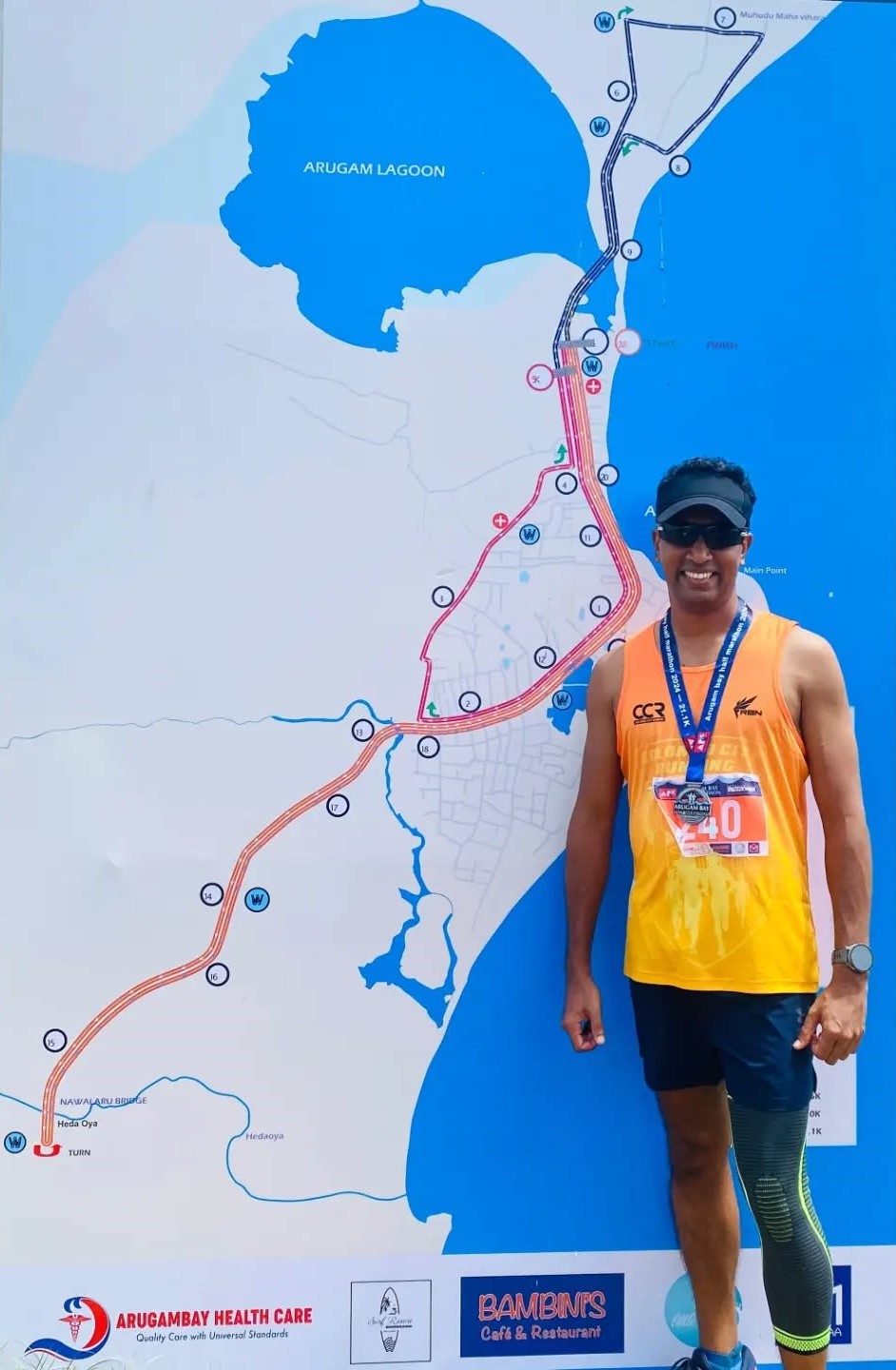
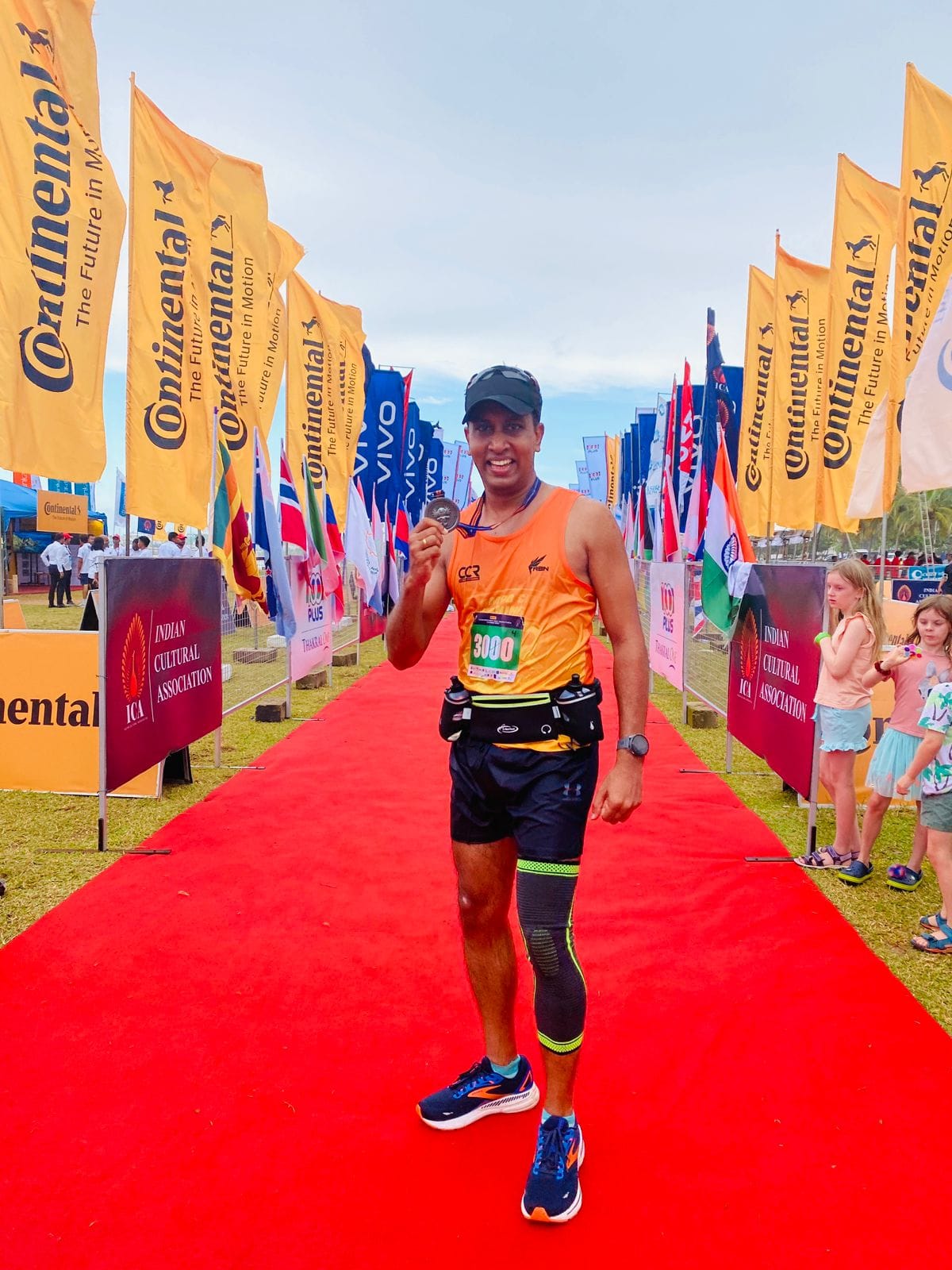
ICA International Half Marathon: Running with a Team (1st September 2024)
Just two weeks after completing the Arugam Bay Half Marathon, I found myself lining up for my second one—the ICA International Half Marathon. This time, I approached the race with two key changes.
First, I did my homework on energy gels—understanding the different types and how to use them effectively. I chose Fast&Up energy gels (caffeine-free, lime and lemon flavored), and followed a strategy: one gel five minutes before the race, and another every 40 minutes—roughly at the 7 km and 14 km marks. The energy boost made a noticeable difference in maintaining my rhythm throughout the run.
Second, I ran with a small group of friends from Colombo City Run. They were all chasing personal bests, aiming to maintain a steady pace of 6:10 min/km. I told them I’d try to hang on—but to my own surprise, I not only kept pace, I even had enough gas left in the tank to push harder towards the end. With their encouragement, I picked it up and ran ahead.
Running with a group—and especially having someone pace you—felt remarkably similar to SCRUM practices in project management. Tharick, who paced us that day, was essentially our Scrum Master. He kept us focused, reminded us to breathe, to hydrate, to relax. His presence allowed the rest of us to forget our watches and just run with intention. We chatted, stayed in rhythm, and pushed each other forward.
I crossed the finish line with a time of 2 hours and 14 minutes—a solid 10-minute improvement from my previous half marathon. It was a reminder of how preparation, teamwork, and a clear strategy can elevate your performance—not just in races, but in any project you take
In addition to running, I also built dashboards using Google Looker Studio to visualize my progress. With my background as a Software Engineer, I was able to pull data from RunKeeper and Strava to create a custom data source. Remember that New Year’s resolution? These dashboards became a powerful tool to track and stay motivated throughout the year, giving me a clear view of how far I’d come—and how far I had left to go.
I truly believe that Project Management is a life skill—one that extends far beyond the workplace. When applied to something like half marathon training, it brings structure, discipline, and a sense of purpose to every step of the journey. With clear goals, consistent progress tracking, and a mindset focused on continuous improvement, you’re not just training for a race—you’re managing a project with you as the end product.
As Benjamin Franklin once said, “If you fail to plan, you are planning to fail.” So set your milestones, trust the process, and run your plan.
Now, lace up those shoes and get started on your next big project—your half marathon.
 Extraordinary pages of an ordinary life
Brilliant read! ✨
I really enjoyed how you mapped project management concepts into your half marathon journey with scope, wbs, risks, and even a dashboard all in action 📊🏃♂️. Tharick as the Scrum Master? That’s gold.
I’ll definitely be revisiting this post when I plan my next HM ✅.